Why You Sound Better Alone Than In Front Of People
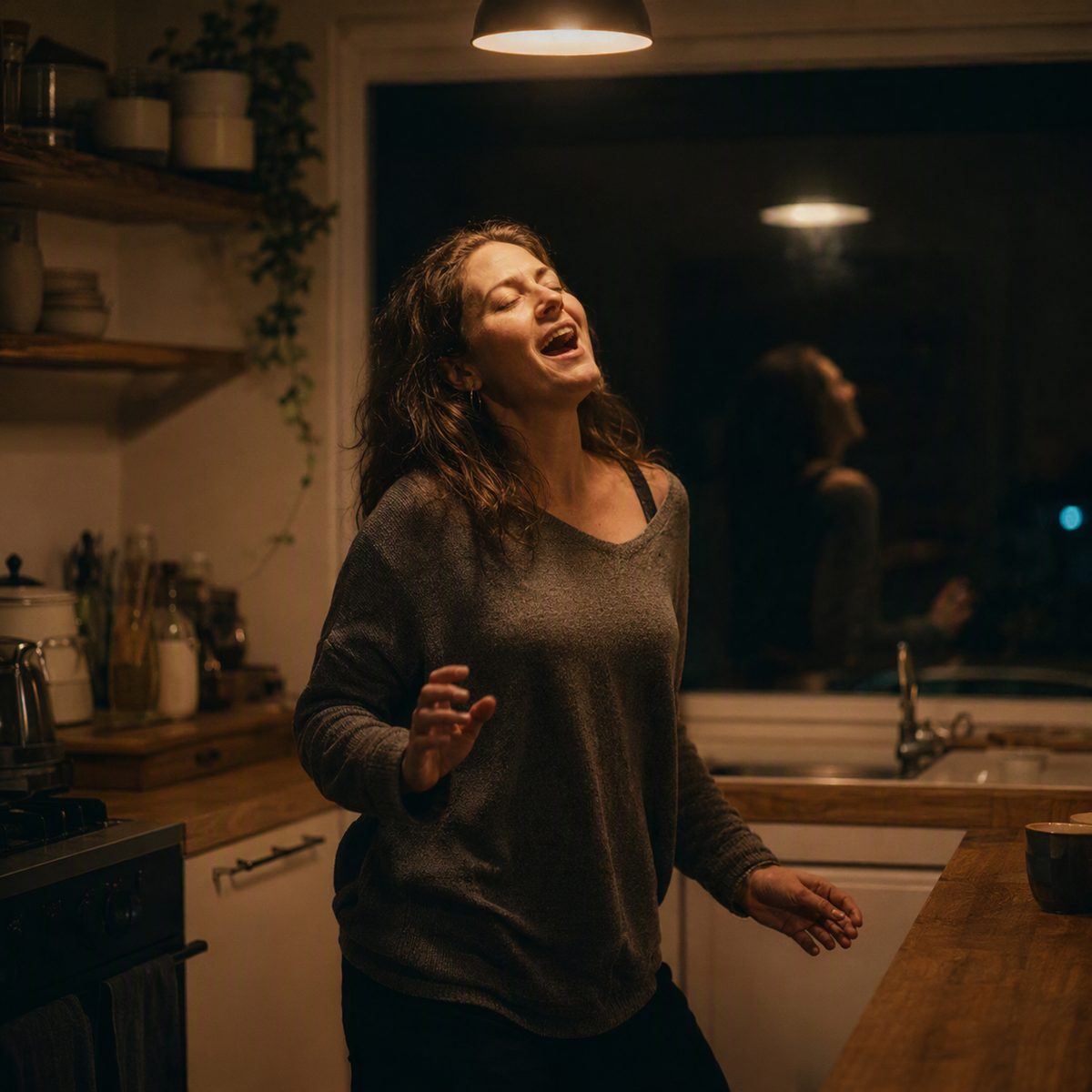
In the kitchen you sound like a singer. In front of one person you sound like someone apologising. That gap is one of the most common things people bring me, and it is not a mystery.
Alone, you are not managing anything
Singing alone, your attention is entirely on the song. You are not monitoring how you look, not tracking whether the listener is enjoying it, not preparing an excuse for the high note.
All of that monitoring uses the same attention the singing needs. Add an audience and you have split your processing between two jobs, one of which is useless.
The voice does not get worse because you are being watched. It gets worse because you have stopped paying attention to it.
A lesson is a controlled version of the thing you are scared of. One listener, who has heard every kind of voice, who is not there to judge you and who has told you so. That is about the safest exposure available, and it is why lessons help with this specifically.
You also physically change
Watch someone sing alone and then sing observed. Alone, the posture is open, the breath is low, the jaw is loose. Observed, the shoulders creep up, the breathing moves into the chest, the jaw sets.
None of that is chosen. It is a threat response and it is automatic. But it is exactly the opposite of what a voice needs.
This is why generic advice to relax fails. You cannot instruct your way out of a reflex.
Recording yourself is the bridge
A recording is being observed with the volume turned down. Nobody is in the room, but something is listening, and most people feel a version of the same tightening.
So it is a usable middle rung. Record a phrase, listen back, record it again. You get used to being captured, and you get objective information about your voice at the same time.
Most singers hate the sound of their recorded voice at first. That fades, and what is left is genuinely useful.
I sing with students when it helps. If you are freezing, me singing alongside gives you something to lean on and takes the spotlight off. I can still hear exactly what your voice is doing underneath mine.
Shrink the audience, do not remove it
The route is not to avoid people until you feel ready. You will never feel ready, because readiness comes from having done it.
One trusted person. Then one person you know less well. Then two. The gap closes because you keep proving to yourself that nothing catastrophic happens, not because you eventually become fearless.
Keeping the alone version
The aim is not to perform your way past this. It is to make the observed version more like the private one, and that means changing your attention rather than your courage.
Alone, you are attending to the song. Observed, you are attending to yourself. So the practical work is learning to put your attention back on the song while somebody is in the room, which is a skill and improves with repetition like any other.
Sing the same phrase alone and then observed, back to back, and notice what changed. Not what sounded worse, what you were thinking about. The answer is usually obvious and it is usually the whole problem.
What I would do in your lesson
I would get you singing the way you do when you are alone, which usually means taking the pressure off before we do anything technical. Then we work on keeping that version when the attention comes back. The good singing is already in there, it just disappears under observation.
Book OnlineWorking on this on your own is slow. In a live one-to-one online singing lesson I can hear what is actually happening in your voice and fix it in real time. More about how I teach, or how I work with singers who have ADHD.
Related articles
- Why You Freeze When Someone Watches You Sing
- Perfectionism Is Hurting Your Singing
- The Fear Arrives Before The Note
Matt Thompson trained at the Academy of Contemporary Music and has taught singing for more than 25 years, from complete beginners to recording artists and performers with international careers. He teaches live one-to-one online singing lessons from a mobile studio, and has ADHD, which is why every lesson comes with a recording, a written summary and a clear plan rather than something you have to remember. Read his story.