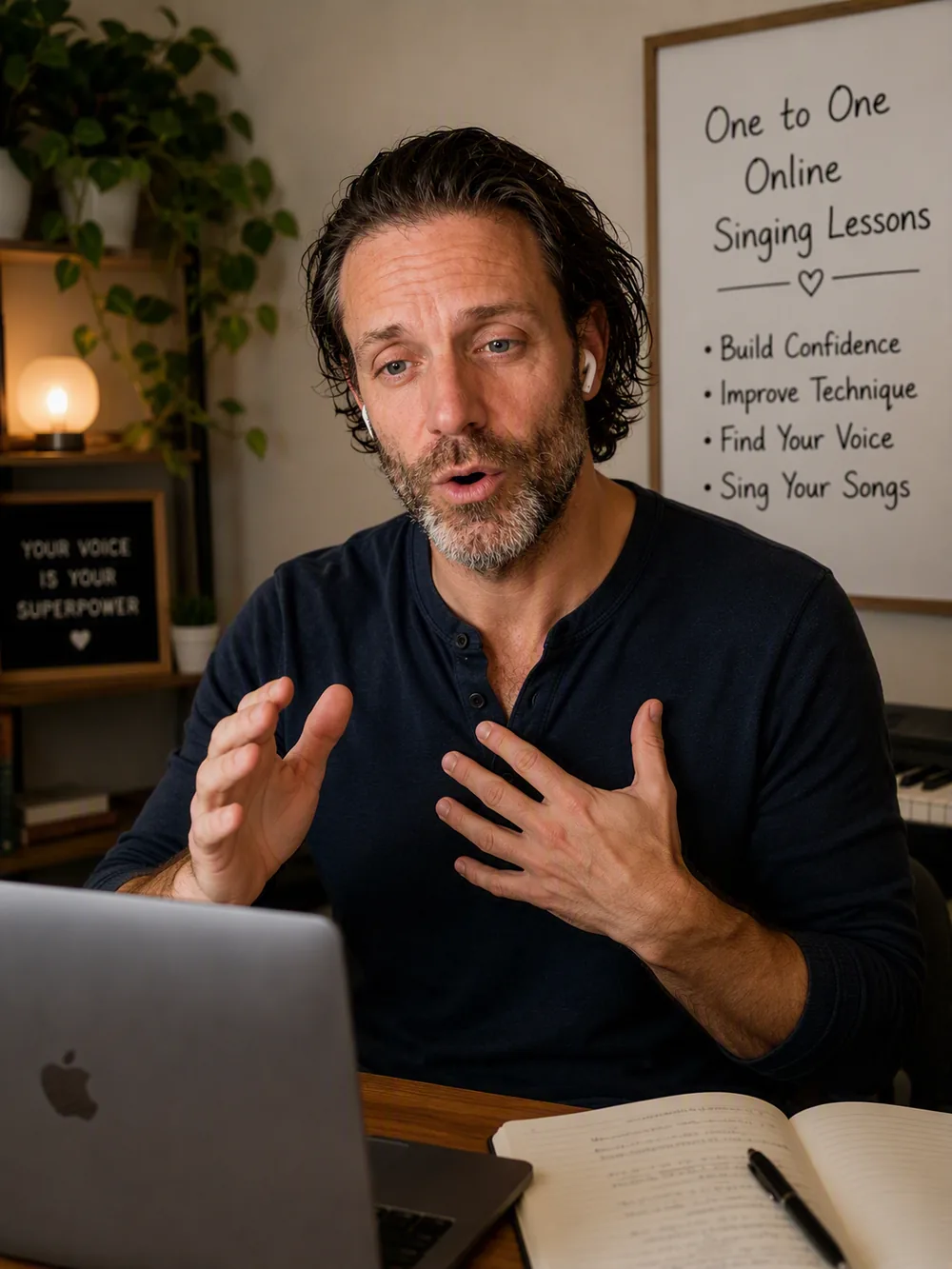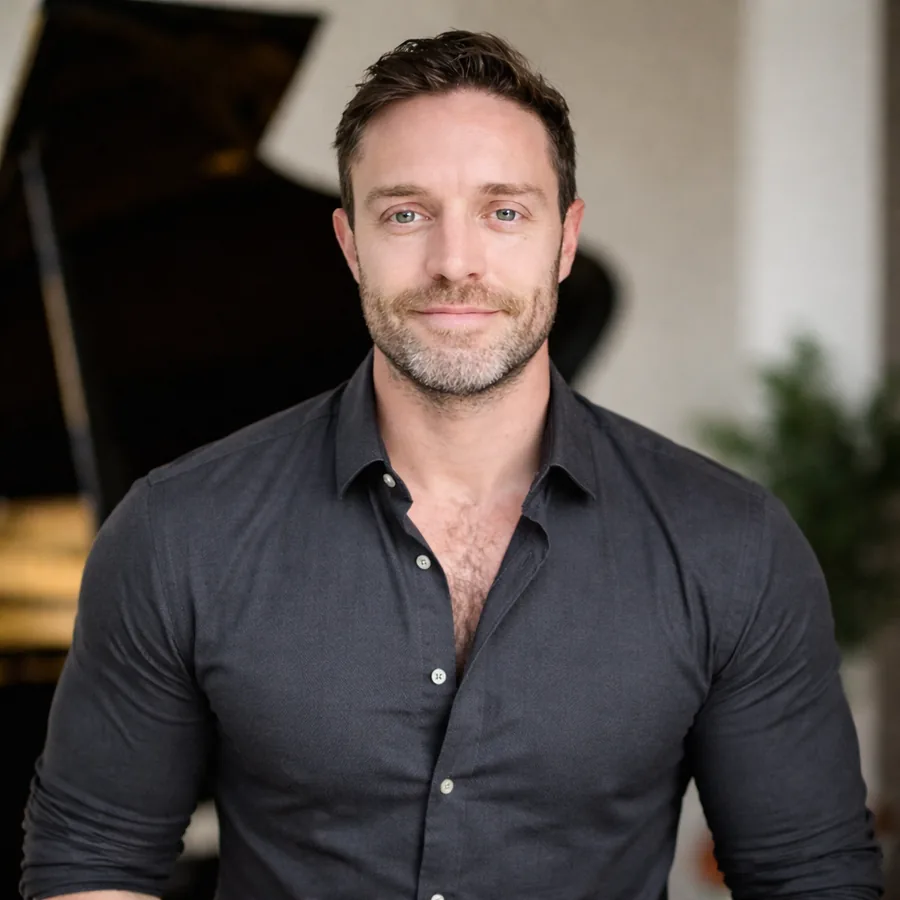
Live one-to-one online singing lessons that make you sound more like you, not less
Most training smooths singers out. Same exercises, same technique, same polished result, and the thing that made you interesting quietly disappears.
I work the other way round. I find what is actually stopping you, remove it, and leave your individuality intact. Every lesson is live, one to one, taught personally by me, built around your songs.
30 minutes. Normally £50. No hard sell, and you do not have to decide anything on the day.
Never had a singing lesson? Good. That is how most people arrive here. You will not be judged, you are allowed to be bad, and you can keep your camera off if that helps.
Individuality is the point, not a side effect
Generic voices bore me.
A singer can be technically perfect and completely forgettable. That is not a compliment to the teaching, it is a failure of it. Technique exists to give you access to your own voice, not to replace it with somebody else's.
So when we work together I am not trying to make you sound like the artist you admire. I am trying to find out what you sound like when nothing is in the way.
That usually includes the bits you think are wrong. A little roughness, an unusual texture, a break you have been told to hide. Often that is the most interesting thing about your voice, and the thing that makes people listen.
What I will not do
- Run you through the same exercise routine I give everyone else
- Train the character out of your voice
- Teach you to imitate somebody more famous
- Tell you it was great when it was not
Who this is for
Four very different starting points. The same approach, because the approach was never a formula.
ADHD or autistic
I have ADHD myself. One change at a time, no telling off for a bad week, and a written plan after every lesson so nothing depends on memory. How I teach neurodivergent singers
New to singing
You have never had a lesson and you are slightly terrified of the first one. Good. That is the most common way people arrive here.
Developing singer
You can sing, but something keeps getting in the way. The high notes, the consistency, the nerves, the sense that you are copying somebody else.
Performer or recording artist
You have a session, a role, a language, a deadline. You need the problem solved now, not in six months.
The note is usually not the problem
Watch a singer approach the line they are dreading and you will see it before you hear it. The face changes. The body braces. They start pushing before they reach the note.
The note was never the issue. The anticipation of the note was.
That is what I listen and look for. Not just the sound, but the flinch before it. Then we make one small change: the mouth shape, the vowel, the pressure, where you place it, what you are thinking about, sometimes just what you are picturing while you sing it.
Small adjustment. Different voice.
What actually happens in your hour
No two lessons are identical, because no two singers are. This is the shape most of them take.
How are you, how is your voice, what has happened since last time, what are we working on. If I hear tiredness or strain, I change the plan.
Sounds, sirens, patterns, chosen for you and for today. I am listening for pressure, break points, tension, whether you are pushing.
We isolate the one thing that matters most. I explain it. If that explanation does not land, I explain it a different way. Then another. I keep changing the language until it lands.
Into a real song. Your song. I stop at the exact word. I tell you what I heard. I show you the alternative. You do it. We put it back in.
A longer section, to see whether the change survives in context.
What we found, what is next, what to practise, where to look in the recording.
You leave with
- A link to your own lesson folder, which stays there for you to return to at any time
- The recording of the lesson inside it
- A written summary of everything we worked on
- A clear path setting out exactly what to practise before next time
Your lesson folder
This is the part most singers tell me they did not expect.
You do not have to remember what I said. After every lesson you get a link to your own folder. Inside it is the recording, a written summary of what we covered, and a clear path telling you exactly what to work on next.
It stays there. You can open it on the bus, the week after, or three months later when something we fixed starts slipping again. Nothing depends on your memory or your notes.
Most people leave a singing lesson with a vague feeling that it went well. You leave with a written plan.
Normally £50. Thirty minutes, one to one, with me.
The work behind the teaching
This is what a £85 hour is actually built on. Alongside the people who have never had a lesson in their life.
English pronunciation for international artists
A large part of my professional work is English diction for artists whose first language is not English. Vowels, consonants, diphthongs, stress and fluency, worked word by word until the line sounds natural rather than learned. It is a specialist skill, there are very few people who do it at this level, and it is one of the main reasons producers call me.
Film and recording
I work with a film director and his artists on the vocals for a film's lead song. That is pronunciation, phrasing and delivery, getting a specific performance to land in the studio, to a deadline, with other people in the room and opinions flying.
Stadium and tour preparation
I prepare artists for tours and large venue performances. That work is stamina, consistency and making sure a voice survives night after night, plus the songs themselves. When thousands of people have paid to be there, the voice cannot be a variable.
International artists
I work with established performers and recording artists with international careers, particularly across Spain and India, as well as actors and screen performers who are required to sing. Some have been with me for many years.
More about film, recording and English diction work
I do not name clients on this website. Some work is confidential, and the rest is not mine to advertise. If you are booking me for a project and need references, ask me directly.
A mobile studio, and a very good internet connection
I taught in person in London for more than fifteen years. When teaching moved online I discovered I got better results that way, so I sold up and moved into a motorhome.
That was five years ago. I am still in it, still teaching, and it means I can work with you wherever you are and wherever I happen to be.
It also means my whole setup is built for this. Proper microphone, proper monitoring, and a room I control. You are not getting someone balancing a laptop on a kitchen table.
How I teach
Getting into the singer's mind so they can get out of their mind.
Every voice is different, so every route is different. I work out whether what is blocking you is technical, psychological, stylistic or linguistic, because treating a confidence problem with a breathing exercise wastes your money.
Then the smallest change that works. Mouth shape, vowel, pressure, placement, what you are picturing, sometimes just permission to stop trying so hard.
I will tell you the truth about what I hear, directly, without humiliating you. That is the same whether it is your first lesson or a session for a film.
What unlocking a voice actually looks like
Three notes to three and a half octaves
He arrived with three notes. Not three octaves, three notes, and that was his entire vocal range. I told him honestly that he might be happier playing another instrument.
He asked me to teach him anyway. So we did it properly, intensively, almost a crash course, and we unlocked the whole thing. He ended up with over three and a half octaves and went on to become a recording artist who is now well known in India.
It is the biggest job I have ever done, and it changed the course of my career as much as his.
An average singer, and my first ever student
A regular at the restaurant I managed kept asking me to teach her husband. I kept saying no. Eventually I agreed to six lessons just to end the conversation.
He was an average singer when he walked in. He booked more lessons, then more, and he became genuinely outstanding. He told everyone he knew, a London management company found me because of it, and that is the only reason I do this for a living.
The moment the penny drops
A drag performer who was already good, already building a name, and singing live rather than miming. Resonance was the thing that would not land. It took a while, as it often does.
Then one lesson he looked up with a huge grin and said, "I get you. I completely get everything you're talking about." I can always see that moment arrive.
His voice opened after that. He went from a very good singer to a genuinely remarkable one, and he has not stopped since.
Almost every singer I meet has more in them than they realise. My job is getting them to hear what I can already hear.
And in their own words
Every line below comes from a review a student wrote themselves.
From wondering what she had got herself into, to singing in front of an audience
"I really wondered what I was getting myself into on the first week. I feel I am confident enough to sing in front of a small audience, which was my initial goal."
Vivienne Dargan
From no confidence in her voice, to notes she thought were out of range
"I no longer felt very confident in using my voice. We learn valuable techniques to enable us to hit notes I would have thought were out of my range."
Former student, returning after years away
From years of self-teaching, to more progress in a few months
"I've improved more in a few months than I did in years of trying to teach myself. I'm now singing songs I never thought I could."
Sarah K.
From several teachers, to finally understanding her own voice
"I've come to understand more about my voice through these lessons than I have with other teachers. He is extremely perceptive in identifying the cause of any problems with the way you sing."
Jane Morris, professional vocalist and coach of 25+ years
From nervous about singing online, to comfortable from day one
"I was nervous about online lessons, but Matt's setup and teaching made me feel comfortable from day one. I can hit notes I never thought possible."
Emma L.
From understanding technique, to actually using it
"Matt makes it easy to understand technique and actually apply it to my singing. The recordings he sends after each lesson are invaluable for practice."
James R.
Choose your path
30-minute consultation
Normally £50, save 50%
- Vocal assessment
- Goal discussion
- At least one change you can hear
- No obligation to continue
One hour lesson
Per lesson
- 60-minute live one-to-one lesson
- Real-time feedback
- Personalised exercises
- Lesson recording provided
- Practice notes included
10-lesson block
£70 per lesson, saving £150
- Ten 1-hour sessions
- Custom long-term plan
- Email support between lessons
- Priority booking
Your consultation, 30 minutes, £25
Normally £50. Here is exactly what happens, because most people are nervous about this bit.
You tell me why you are here and what is getting in the way. You sing something, whatever you like. If that feels like too much, you can turn your camera off. I will turn mine off too if it helps.
What you sing in those first minutes does not define your voice. I am simply being introduced to it. You are allowed to be bad. You are allowed to forget the words.
I will tell you specifically what I heard, not a general verdict. We will make at least one change you can hear or feel. Then I will tell you what I think you need.
There is no hard sell. You do not have to decide anything on the day.
Common questions
I have never had a singing lesson. Is that a problem?
No. Complete beginners are the most common way people arrive here, and the approach is the same one I use with professionals. Nothing is assumed and nothing is rushed.
What if I sing badly in the consultation?
Then you sing badly, and we both learn something useful. One nervous attempt does not define your voice, and I will say so before you start.
Are online singing lessons as good as in person?
For one-to-one coaching, yes. I can hear pitch, tone, breath, strain and register changes clearly, and I can see tension and anticipation on your face. Lessons are live on Microsoft Teams, in real time, never pre-recorded.