Why Having ADHD Shapes the Way I Teach Singing
Having ADHD does not mean I know how every neurodivergent singer learns. It means I never assume there is only one correct way to make the work understandable.
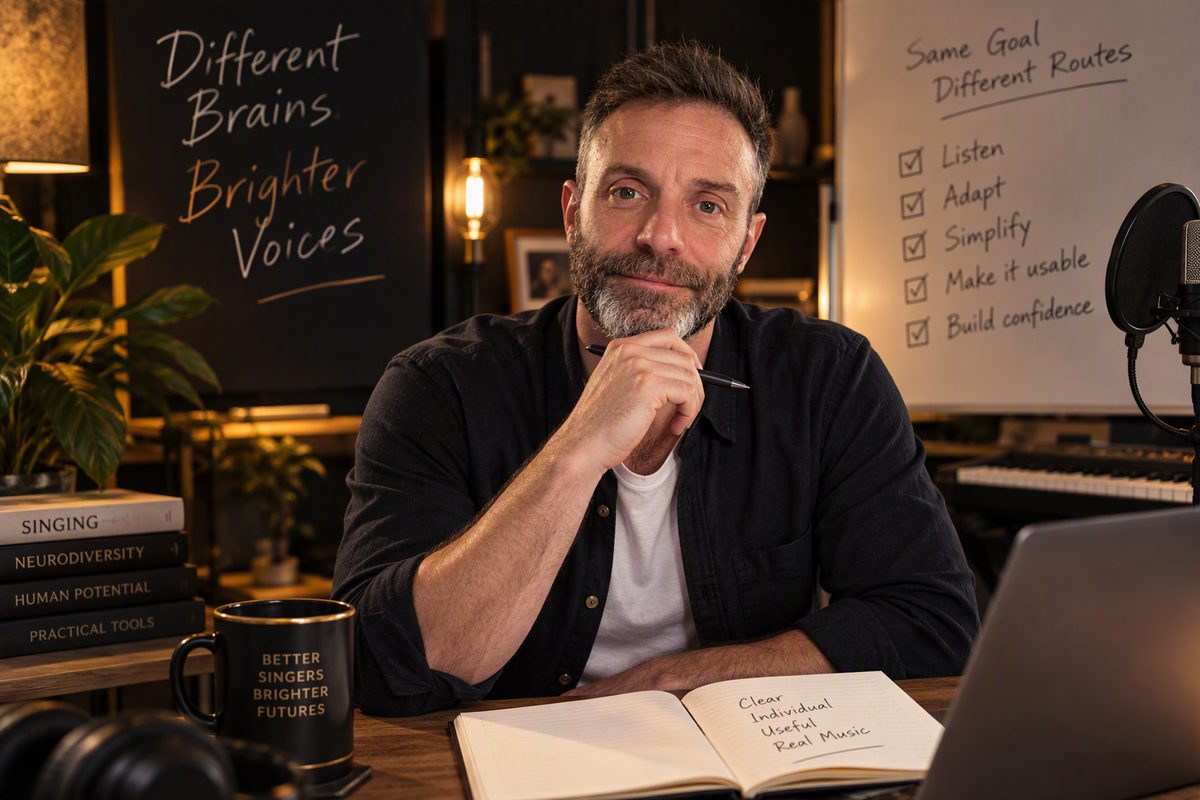
Personal experience is a starting point, not a template
Having ADHD shapes how I think about teaching, but it does not give me a shortcut to understanding another person. Neurodivergent singers are individuals. A method that makes sense to me may not make sense to someone else, and a singer may want a different kind of explanation from one song or session to the next.
My responsibility is not to guess what a singer needs from a diagnosis. It is to ask what they are trying to do, notice what is and is not clear, and make room for more than one route into the musical task. Personal experience can make me alert to the possibility that an instruction is not landing; it cannot tell me exactly why.
Make the musical question easier to see
A broad instruction such as “sing it more freely” can leave too much unexplained. We can make the question more concrete: where does the phrase change, what do you hear on the sustained note, or which part of the lyric becomes difficult to keep in view? The answer might be a demonstration, a short spoken explanation, listening to the accompaniment, or trying the passage in a different way.
Those are options, not a prescribed ADHD teaching method. The singer can say what is useful, ask for another explanation, or decide that a suggestion does not fit. Clear teaching should make a musical choice easier to understand without treating the singer as a problem to be fixed.
Use a song to test an idea
Suppose a singer wants to work on a line that feels difficult to remember or coordinate. We could choose one short passage from a song they already know, agree what to listen for, and try it with one change at a time. That might mean speaking the rhythm before singing, hearing a piano cue, or reducing the task to one phrase. The singer chooses which route to test.
Then we listen for the musical result together. Did the entrance feel clearer? Was the lyric easier to follow? Did the change help the singer hear the phrase, or did it add another thing to manage? These observations can guide the next attempt, but they do not prove that the same strategy will work for another person or another song.
Separate what I notice from what I assume
I can describe what I hear: a phrase starts late, a word changes, or the singer loses the musical cue when the accompaniment shifts. I can offer a coaching interpretation and suggest a way to explore it. I cannot infer a person’s experience from that observation alone, and I should not present a coaching idea as a fact about ADHD.
That distinction matters because a lesson is collaborative. The singer’s account of what happened is essential information, not something to overrule with my own explanation. If my wording is unclear, we can change it. If an experiment is not useful, we can stop or choose another. There is no single correct route through a song.
Teaching is responsive, not diagnosis-led
Being open about my ADHD is not a promise that I can anticipate every need. It is a reminder to stay curious, explain what I am asking a singer to try, and check whether it makes sense to them. I want a singer to be able to ask for a different explanation without first having to justify why the first one did not work.
The aim is still the music: understand a particular phrase, hear a particular change, and make a choice that belongs to the singer. My experience influences the questions I remember to ask. The singer’s own experience determines which answers are useful.
Bring a song and a question
A paid Consultation can explore a specific singing task and the ways of explaining it that make sense to you. It costs £25 for 30 minutes live on Teams and is coaching, not diagnosis or treatment.
Request a Consultation